Lightfall
Lightfall is a control environment for your beamline. It puts live device control, Bluesky plan execution, data browsing, an electronic logbook, and an embedded AI agent in one application — one window, one login, for the things a beamline shift actually consists of.
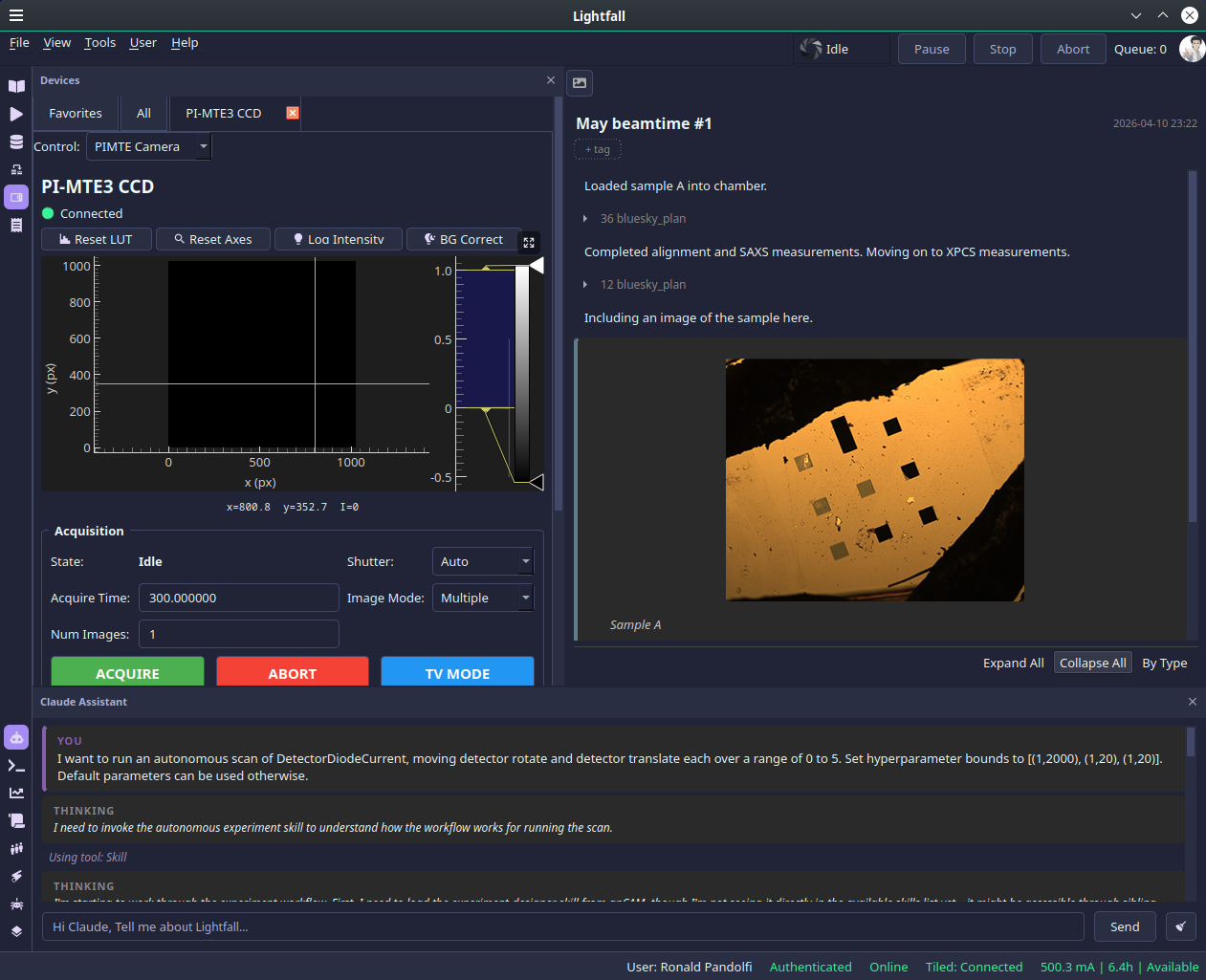
Lightfall at COSMIC-Scattering: detector control with live image view (left), the experiment logbook with an attached sample image (right), and the embedded assistant setting up an autonomous scan (bottom).
What is it?
Device control — live panels for motors, detectors, and signals, built on Ophyd and EPICS Channel Access
Plan execution — run Bluesky scans interactively, with live plotting; pause, resume, or abort mid-run
Data browsing — search and review collected runs through a Tiled catalog, filtered by date, plan type, or exit status
Electronic logbook — entries are created automatically as runs start, finish, or fail, and as devices are actuated; manual notes and viewport screenshots attach to the same record
An embedded AI agent — a Claude-based assistant that can operate the instrument (move motors, run plans, inspect data and panels) and build new UI panels and scan plans when you describe them in plain language
The last item is the unusual one. The agent doesn’t just answer questions about the software — it modifies it. Ask for “a panel with the sample stage readbacks and a jog button for theta” and it writes the panel, loads it into your running session, and commits the code to your beamline’s git repository.
🖼️ Image placeholder — Screenshot: the agent chat mid-conversation, with a freshly built custom panel appearing in the workspace
Why you might care
Customization happens during your shift, not after a developer queue. Beamline software requests usually mean filing a ticket and waiting. Here the agent makes the change while you watch, and every change is a git commit — reviewable, revertible, and persistent across sessions. Throwaway one-experiment panels are cheap; the good ones graduate into your beamline’s plugin repository.
Adaptive experiments instead of exhaustive rasters. Lightfall connects to Tsuchinoko over its message bus, and the agent walks you through designing a gpCAM-driven adaptive scan — the Gaussian-process engine decides where to measure next, concentrating beamtime where the data is interesting. Live visualization shows the surrogate model and the measured points as the experiment runs.
🖼️ Image placeholder — Screenshot: adaptive-scan visualization showing the gpCAM surrogate heatmap with measured points overlaid
One login for control and data. The same sign-on that authorizes motor moves authorizes data access. Runs you acquire are cataloged to Tiled automatically, tagged with your identity, and access is enforced per run — no second account, no shared group password.
The experiment documents itself. Run starts, completions, and errors land in the logbook without anyone remembering to write them down; your annotations and screenshots interleave with the automatic record.
🖼️ Image placeholder — Screenshot: logbook panel showing automatic run entries interleaved with a manual annotation and an attached screenshot
Try it — no hardware required
pip install lightfall
lightfall
Requires Python 3.11 or newer. On first launch, click Continue as Guest to
look around, or sign in with the built-in demo account to run scans: click
Use local account instead, then username user, password user (guest
access is read-only). A fresh install starts with a set of simulated
devices — motors and point detectors with Gaussian responses, plus
temperature and pressure signals — so you can open the device panels, run real
Bluesky scans, and explore the logbook without touching a beamline.
Three things to know about the out-of-the-box experience:
The agent needs Claude credentials. Set the
ANTHROPIC_API_KEYenvironment variable, or authenticate a Claude subscription with the Claude Code CLI (claude auth login). Everything else works without it.Plots and the Data Browser read from a Tiled catalog. A throwaway local server is two commands — Your First Session walks through it.
Facility services are optional. A production Tiled server, Keycloak single sign-on, the logbook server, and real EPICS devices are deployment steps, not prerequisites — the Developer Guide covers wiring them up.
Status
Lightfall is in testing at the COSMIC-Scattering beamline at the Advanced Light Source, where it has run since early 2026. The software is alpha: APIs are still settling, and you should expect rough edges. It coexists with existing control systems — both can address the same EPICS process variables — so trying it does not mean replacing anything.
Lightfall is open source under the BSD-3-Clause license, developed by the ALS Controls Team at Lawrence Berkeley National Laboratory.
Where next
User Guide — getting started, your first session, running plans, the Claude assistant, and the logbook
Developer Guide — architecture, the plugin system, messaging, and deployment
API Reference — formal reference for the programmatic surface